A walk on the first street in the world instead of the shopping street, a tour through the student quarter instead of a city tour, to the horror museum instead of the church: We have ten insider tips for Rome away from the masses - with many small and big surprises.
1. view from the Giardino degli Aranci
Of the seven hills on which Italy's capital was built, the Aventine is the southernmost. On top of the hill is a small, rectangular park. In the 14th century, the Savelli family built a castle here and had it enclosed by high medieval walls.
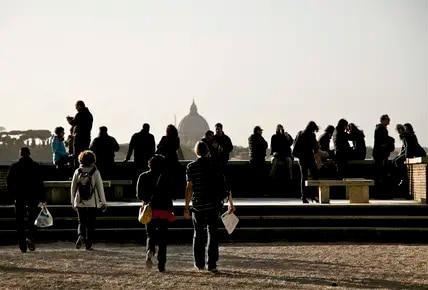
Sunset over the Giardino degli Aranci.
At this point you will find external content from Qualtrics Ireland Limited that complements this article. You can view it with one click.
I agree to external content being displayed to me. This may transmit personal data to third party platforms. Read more about this in our privacy policy.
Savello Park is now known as Giardino degli Aranci - and as an insider's tip for a magnificent view over the city, where you can see from the bend in the Tiber River to St. Peter's Basilica. The view is particularly beautiful at sunset.
2. cult and culture in the Testaccio district
If you wander through Rome in the evening, you can't miss Trastevere. The district is famous for its nightlife. An alternative lies in the southwest of the city. The Testaccio quarter is a former workers' district and got its name because of a hill that was created in ancient times as a dumping ground for broken amphorae that could not be reused.
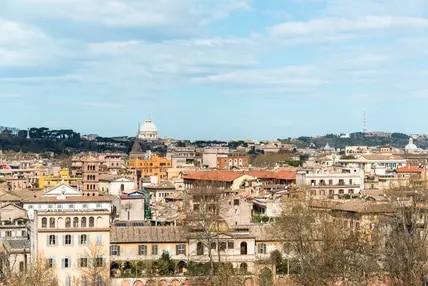
A walk over the Testaccio hill gives you a view of the city from a higher vantage point.
In the 1960s, a change happened. More and more cultural institutions discovered the district for themselves. Today, Testaccio around Monte dei Cocci is known for lively bars, fine restaurants and cool clubs, but with fewer tourists than Trastevere.
3. student life in San Lorenzo
Not far from the main railway station Termini, Rome's young scene meets in the student quarter San Lorenzo. At first glance, the neighbourhood is nothing special. Since San Lorenzo was bombed during the Second World War, there are hardly any historical buildings.
Instead, countless inexpensive restaurants, bars and, of course, the university have settled here. Classical travellers don't come here too often, which makes the district authentic, cheap and less touristy.
4. Art Nouveau in the Quartiere Coppedè
If you have a soft spot for architecture, you should definitely go to Quartiere Coppedè. This is not a district in its own right, but a neighbourhood where squares, apartment buildings and villas were built in Art Nouveau style. The architect Gino Coppedè created the quarter between 1915 and 1926.
Today, walking through the Quartiere Coppedè, you have the feeling of being in an open-air Art Nouveau museum thanks to 27 villas and 18 squares.
5. The side streets of Piazza Navona
Piazza Navona is one of the most famous and colourful squares in Rome, always bustling with activity. There are always countless travellers here. But it would be a shame to demonise this corner of Rome as a tourist trap. It's better to see the Piazza Navona from a different perspective.
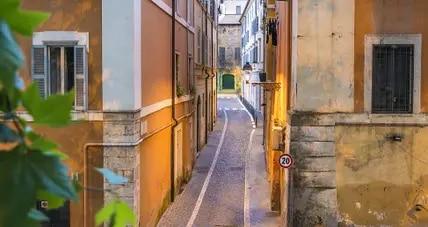
There are many hidden alleys around the Piazza Navona.
Leave the square behind and turn into the side streets. Between Piazza Navona and the Tiber River, there are several original alleys full of charm. Most travellers stay in the busy areas, so you have a good chance of finding some peace and quiet in the narrow streets. There are also small restaurants, bars and cafés.
6. Graffiti in Tor Marancia
Just outside the centre of Rome hides an exciting project that is considered an insider tip: the social housing project "Tor Marancia Big City Life". In the former problem housing estate Tor Marancia, graffiti artists from all over the world have left their works on 22 house walls.
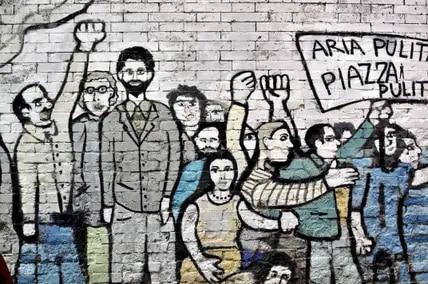
Graffito in the Tor Marancia neighbourhood.
It is worthwhile to walk slowly through the alleys and look at the paintings in peace. Each of the artworks tells its own story, and some of them also relate to the people who live in the buildings behind the walls.
7. film history in the Cinecittà
Cineastes should take a trip to the outskirts of Rome. South-east of the centre lies the film city of Cinecittà, where film history was written. Opened as early as 1937, countless films were shot here, including classics such as "La dolce vita", "Ben Hur" and "The Passion of the Christ".
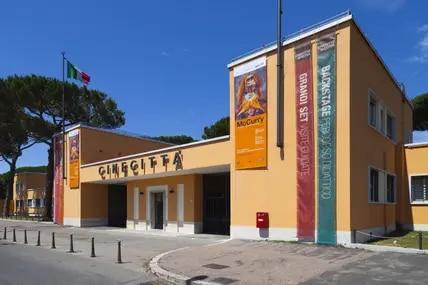
Film fans should definitely go to the Cinecittà.
On a guided tour of the film city, you'll walk through the various sets and learn a lot about Italian film history - away from the crowds, because not too many tourists come here.
Horror in the Profondo Rosso
You'll feel like you're in a film when you go to Rome's most extraordinary museum. The Italian director Dario Argento, who made the film "Suspiria", has opened a horror museum in Rome.
In the basement of the horror shop "Profondo Rosso", the museum offers an insight into alternative horror film history and surprises visitors with its kitschy, creepy surroundings and exciting lighting effects.
9. Walking the Via Appia Antica
If you want to walk in the footsteps of the ancient Romans, you can walk along the Via Appia in Rome. It is called the "first road in the world". The Roman road runs 540 kilometres from Rome to Brindisi in southern Italy.
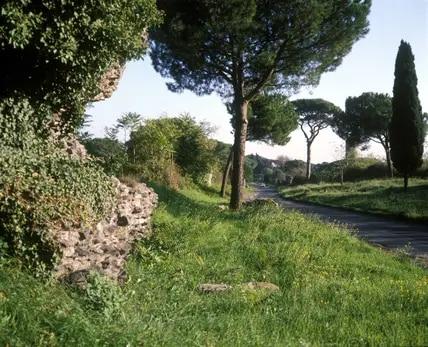
The Via Appia Antica outside Rome.
In Rome, there are still preserved ancient pavements on which the ancient Romans travelled 2000 years ago. The Circo Massimo metro station is 1.5 kilometres from the starting point at Porta San Sebastiano. If you want, you can only walk part of the way or cycle. Those with a car can drive outside the city and explore the Via Appia in the countryside.
10. Adventures in the Catacombs
Under the ground, Rome shows a completely different face. There are more than 60 catacombs in the city. This underground world was created in different eras, the oldest dating back to pre-Christian times. Not only paths were built, but also places for the veneration of saints, meeting places and cemeteries.
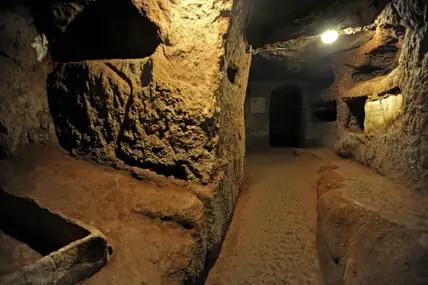
Corridor with burial niches in the underground cemetery of the Catacombs of St. Sebastian.
Out of 60 catacombs, you can visit four today: the Calixtus Catacombs, the Sebastian Catacombs, the Domitilla Catacombs and the Priscilla Catacombs. There are different tours to explore Rome's underworld.